Anthropic open-sourced Agent Skills on December 18. OpenAI adopted it within 48 hours. By February, 160,000+ skills were indexed across 7+ platforms. Here's the adoption map, the forecast, and what's still missing.
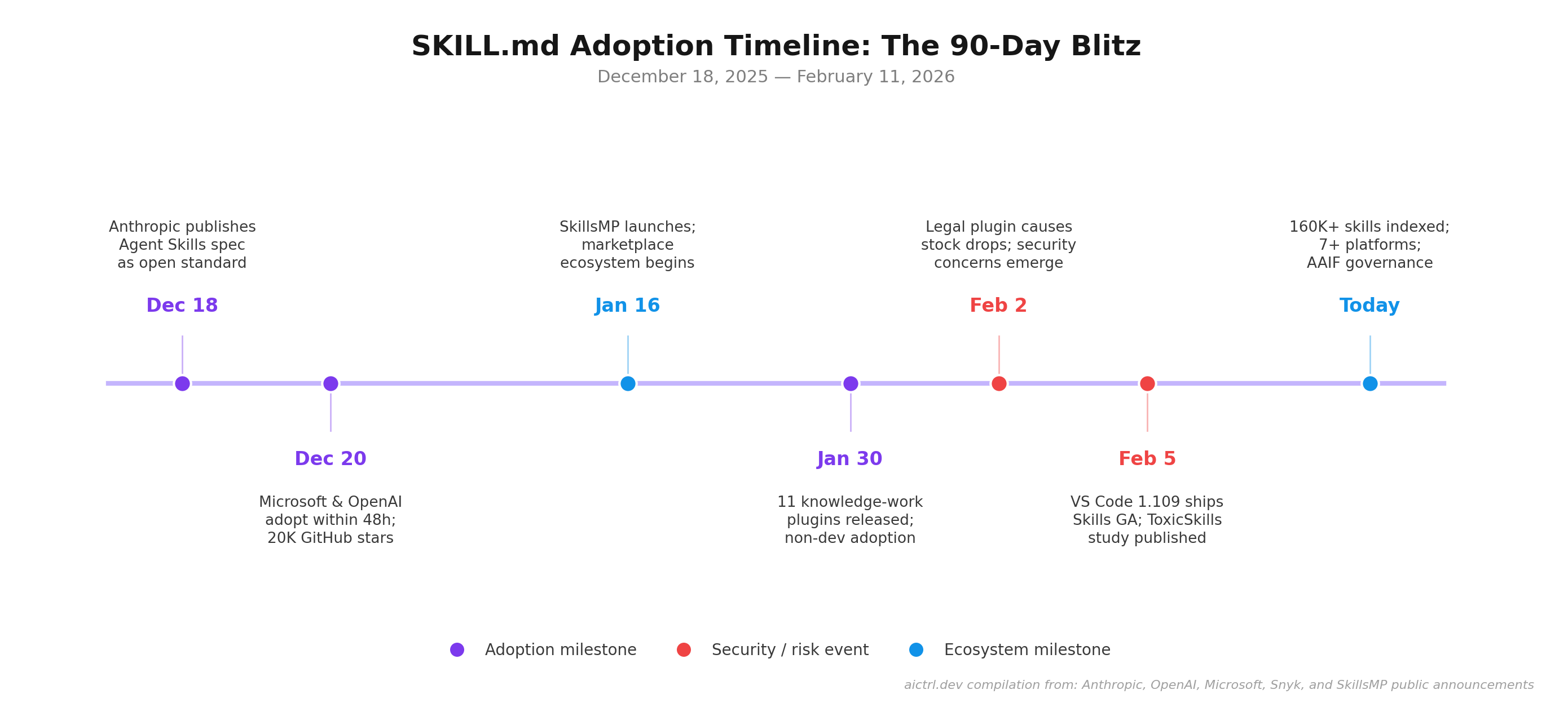
On December 18, 2025, Anthropic published the Agent Skills specification as an open standard at agentskills.io. What followed was the fastest cross-vendor adoption of any AI interoperability standard to date.
Within 48 hours, Microsoft integrated Skills into VS Code and OpenAI added "structurally identical architecture" to ChatGPT and Codex CLI. The anthropics/skills GitHub repository crossed 20,000 stars. Atlassian, Figma, Canva, Stripe, Notion, and Zapier all contributed partner skills at launch.
By February 5, 2026 — fewer than 50 days later — VS Code 1.109 shipped Agent Skills as generally available. OpenAI deprecated their own custom prompts in Codex, directing users to the SKILL.md format instead. This isn't interoperability through negotiation. It's convergence through gravity.
The MCP playbook repeated itself. Anthropic invented the protocol, open-sourced it, and competitors adopted it rather than building their own. The New Stack framed it as "Anthropic's next bid to define AI standards." VentureBeat called it a shift toward a "cohesive, interoperable Agentic Web."
Why did OpenAI adopt a competitor's standard?
The most insightful analysis comes from Lellansin's blog: Anthropic is an upstream model provider, giving it the structural position to make skills a first-class concept. Downstream IDEs like Cursor lacked the position to set cross-platform standards. When Cursor launched .cursorrules, the industry was in "code completion" mode. By the time Skills launched, agent-based workflows had become explicit demand.
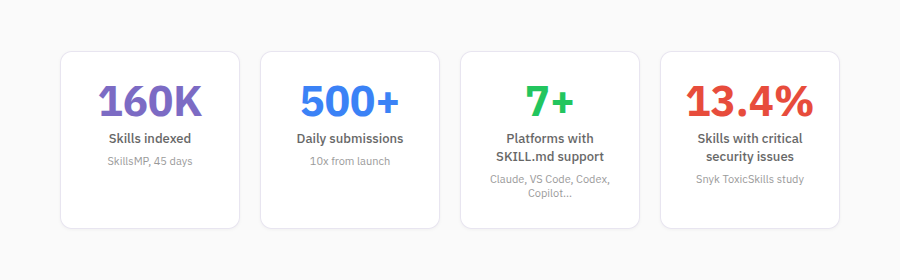
The supply side of the skills economy exploded. SkillsMP, the largest aggregator, went from launch on January 16 to 327,000 monthly visitors and 160,000+ indexed skills in under a month. Daily skill submissions increased 10x — from fewer than 50 per day to over 500 — between mid-January and early February.
At least five independent skill marketplaces emerged organically:
Meanwhile, the MCP (Model Context Protocol) ecosystem — the transport layer that skills ride on — matured rapidly. mcp.so now indexes 17,590+ MCP servers. AWS, Azure, and VMware all launched MCP server integrations, signaling this has crossed from developer tooling into enterprise infrastructure.
"Claude Code accounts for 4% of all public GitHub commits today, trending toward 20%+ by year-end. The future of AI will be about the orchestration of tokens, not just selling tokens at base cost."
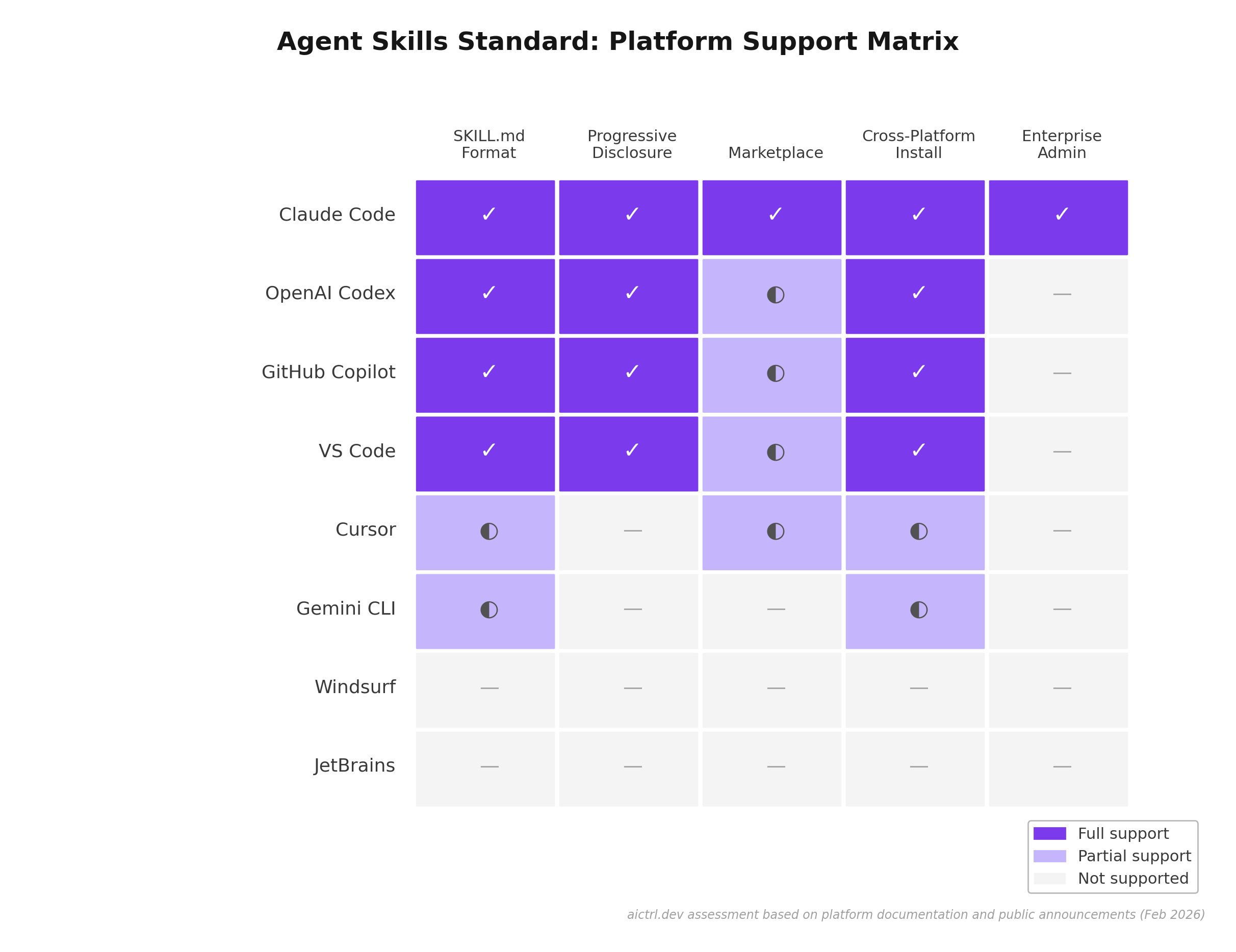
The SKILL.md standard's reach is wide but uneven. Full adoption means supporting the format, progressive disclosure (lazy loading of skill content), marketplace integration, cross-platform installation, and enterprise admin controls. Only Claude Code ticks all five boxes today — but the trend line is clear.
The most telling signal: OpenAI deprecated their own custom prompts system in Codex, directing users to use Skills instead. That's not "also supporting" a competitor's format — it's actively migrating away from their own approach.
In December 2025, Anthropic, OpenAI, and Block co-founded the Agentic AI Foundation (AAIF) under the Linux Foundation. Anthropic contributed MCP; OpenAI contributed AGENTS.md; Block contributed Goose. Google, Microsoft, AWS, Cloudflare, and Bloomberg joined as platinum members. While SKILL.md is not formally an AAIF project, AGENTS.md (project-level configuration) and SKILL.md (reusable capability packages) serve complementary roles in the emerging agentic stack.
The notable absence
Google has partial SKILL.md support in Gemini CLI (format parsing and cross-platform install) but has not shipped marketplace integration, progressive disclosure, or enterprise controls. Their AI Studio Prompt Gallery remains platform-specific. JetBrains uses a proprietary prompt library stored within IDE settings. Both are at the governance table (AAIF members) but lag significantly in implementation depth.
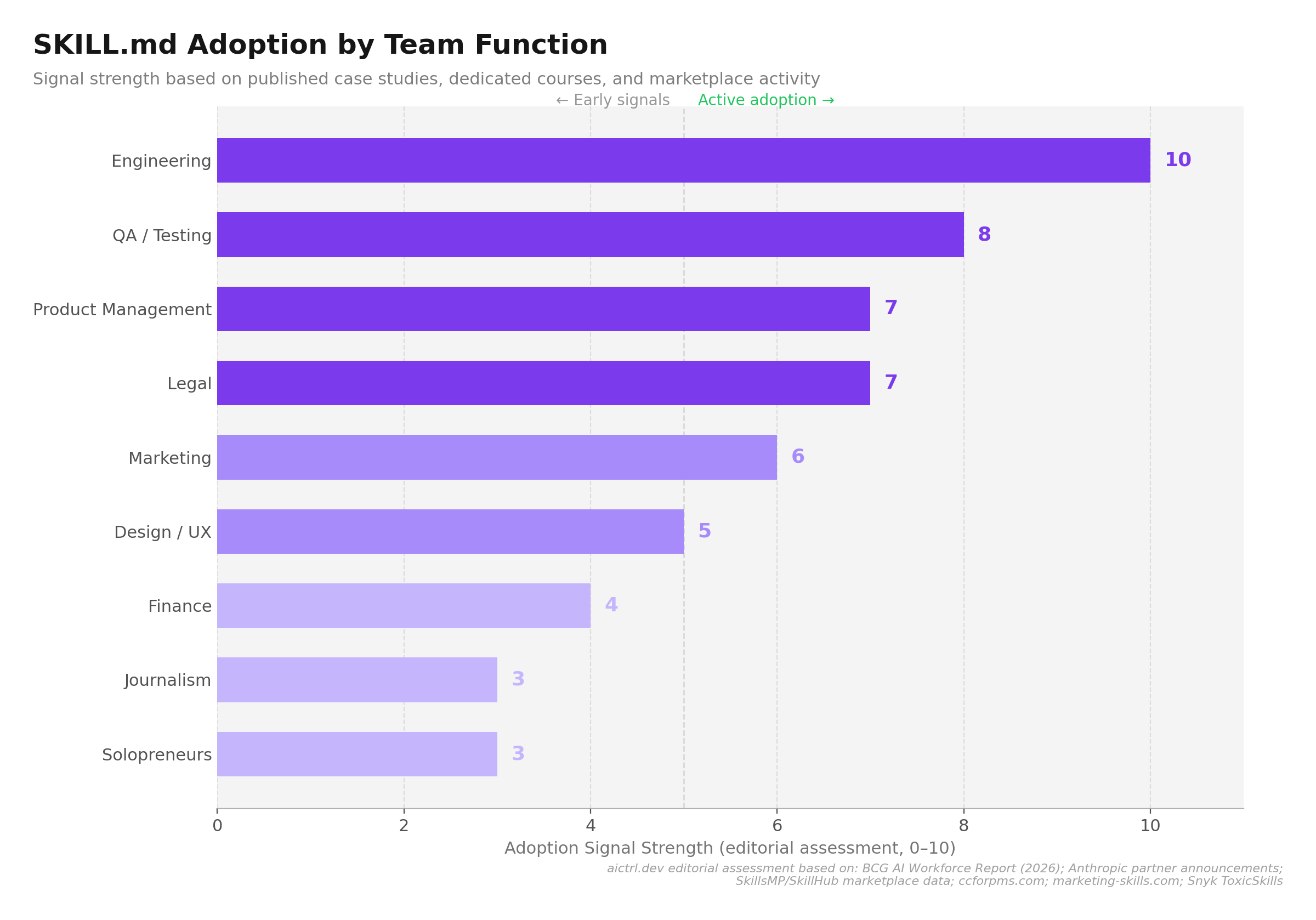
The most surprising finding from our research: SKILL.md is no longer an engineering-only phenomenon. Product managers, QA engineers, legal teams, marketers, designers, journalists, and solopreneurs are actively creating and consuming skills. This matters because it changes the market from "developer tool" to "organizational capability infrastructure."
Product Management: A dedicated free course exists at ccforpms.com. The prodmgmt.world directory curates 180+ PM-relevant skills. One product manager reported generating 42 user stories with acceptance criteria from a single PRD in 10 minutes.
QA / Testing: AI-assisted test creation is accelerating rapidly, with multiple industry surveys reporting majority adoption among QA teams. Dedicated QA skills handle Playwright, Cypress, and visual regression workflows — turning test generation from a manual craft into an agent-driven workflow.
Legal: Anthropic's legal plugin (February 2, 2026) performs clause-by-clause contract review against negotiation playbooks. It triggered stock drops in Thomson Reuters, RELX, and Wolters Kluwer — proof that skills can threaten entire product categories.
Marketing: marketing-skills.com packages 20+ skills for CRO, copywriting, SEO audits, and email sequences, explicitly designed "for non-developer marketers and founders."
Design: Obsidian CEO Steph Ango publicly built official Obsidian skills following the Agent Skills specification — a knowledge management tool, not a coding tool.
"I turned 10 years of headline writing experience into a Claude Skill in 30 minutes."
BCG's 2026 report provides the strategic framing: "70% of AI value comes from rethinking the people component" — only 10% from algorithms, 20% from technology. BCG's top-performing "Trailblazer" CEOs (roughly 15% of those surveyed) allocate 60% of their AI budget to workforce upskilling. SKILL.md is infrastructure for that thesis: it packages human expertise into composable, shareable, role-specific artifacts.
The EU AI Act tailwind
EU AI Act Article 4 on AI literacy has been in effect since February 2025. From August 2026, national authorities begin active supervision and enforcement. While no direct fines apply to Article 4 violations, organizations are increasingly treating AI literacy as a compliance priority. A SKILL.md library with role metadata could serve dual purposes: operational skills AND compliance evidence. No one has built this yet — it's a clear market gap.
Rapid adoption brought rapid exploitation. February 2026 was the skills ecosystem's "left-pad moment" — the event that forces a maturing ecosystem to reckon with trust.
Two studies landed in quick succession:
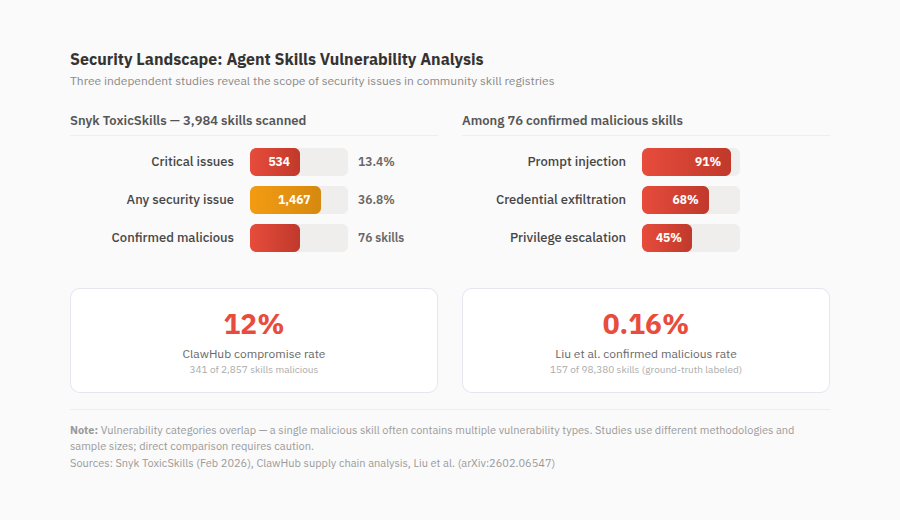
Snyk's ToxicSkills study (February 5, 2026) scanned 3,984 skills from ClawHub. Findings: 534 skills (13.4%) had critical security issues, and 1,467 skills (36.8%) had at least one security issue of any severity. Human-in-the-loop review confirmed 76 malicious payloads. Among confirmed malicious skills, 91% employed prompt injection. Snyk demonstrated that the format's design allows trivial escalation from markdown instructions to arbitrary shell execution.
The ClawHub supply chain attack: Researchers discovered 341 malicious skills in ClawHub's marketplace of 2,857 — a 12% compromise rate. Attackers used typosquatting, crypto-stealing malware, and C2 infrastructure. A single actor accounted for 54.1% of confirmed malicious cases through templated brand impersonation.
Academic research corroborated the findings. Liu et al. (arXiv:2602.06547, February 2026) published the first ground-truth labeled dataset of malicious agent skills, behaviorally verifying 98,380 skills from two community registries. They confirmed 157 malicious skills containing 632 vulnerabilities, identifying two archetypes: "Data Thieves" (credential exfiltration) and "Agent Hijackers" (instruction manipulation).
The structural risk
SKILL.md files are markdown with embedded instructions that agents execute with full system access. There is currently no code signing, no verified publishers, and no dependency scanning for skill artifacts. Snyk found that 13.4% of skills had critical security issues and over a third had issues of some severity. This is the ecosystem's most urgent problem.
The positive signal: responsible disclosure led to 93.6% removal of confirmed malicious skills within 30 days. OpenClaw integrated VirusTotal scanning. But the ecosystem needs structural solutions — not reactive cleanup.
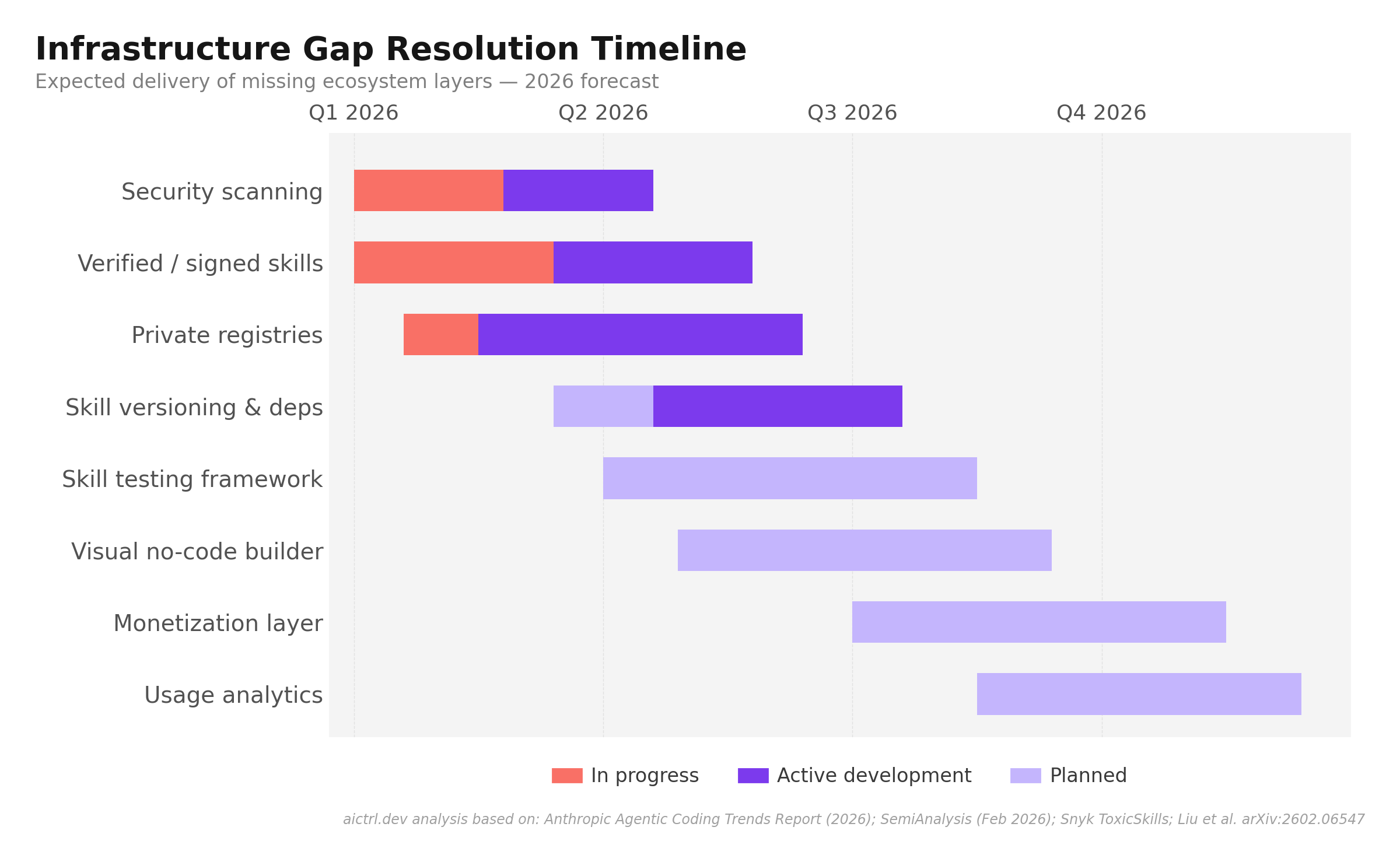
The standard has won. The question is no longer "will SKILL.md become the default" but "how fast will the infrastructure mature to match adoption velocity." Several critical layers are missing.
160,000+ skills indexed. Cross-platform standard solidified. Security reckoning underway. The Agentic AI Foundation provides governance. Enterprise provisioning shipped (December 2025). This is the "Wild West" phase — massive supply, minimal curation.
Expect 2-3 dominant marketplaces to emerge from the current fragmented landscape. Security scanning becomes table stakes. Verified/signed skills and enterprise private registries will differentiate serious platforms from hobbyist directories. Forrester's prediction that 25% of planned AI spend gets deferred to 2027 favors proven, packaged skills over experimental prompting.
Skill testing frameworks, CI/CD integration, and formal versioning become standard. Non-engineering adoption reaches critical mass as dedicated courses and no-code skill builders mature. EU AI Act enforcement (August 2026) creates compliance demand for documented, role-specific AI competency artifacts.
If Claude Code reaches 20%+ of GitHub commits as SemiAnalysis projects, skills become the default way teams encode workflows. Expect paid premium skills, professional skill authors, and organizational skill libraries. The "npm for skills" narrative resolves into actual package management infrastructure.
Early adopters (now): Engineering teams at tech companies, AI-forward enterprises. Accenture is training 30,000 professionals. TELUS saved 500,000 hours. Zapier has hundreds of internal agents.
Fast followers (Q2-Q3): Mid-size tech companies, consulting firms, companies with dedicated AI teams. Will adopt when verified registries and security tooling mature.
Early majority (Q3-Q4): Non-engineering teams within adopter organizations. QA, PM, and design teams adopt as dedicated training and no-code builders become available.
Late majority (2027): Regulated industries, traditional enterprises. Will adopt when EU AI Act compliance tooling explicitly supports SKILL.md-based documentation.
SKILL.md achieved cross-vendor standardization at a pace rarely seen in developer tooling: competitors voluntarily adopted the format within weeks rather than years. The combination of Anthropic originating it, OpenAI adopting it, and Microsoft shipping it GA creates a three-vendor consensus that makes competing formats increasingly untenable.
The five startup opportunities in this space right now are clear: (1) a security layer — the "Snyk for SKILL.md"; (2) a visual no-code skill builder for non-engineers; (3) enterprise skill governance with approval workflows and analytics; (4) a monetization platform with revenue-sharing for skill authors; and (5) cross-platform skill testing ensuring identical behavior across Claude, Copilot, Codex, and Cursor.
For organizations: the companies building their skill libraries now are building organizational muscle memory that compounds. BCG says 70% of AI value comes from people. SKILL.md is how you package what your people know into artifacts that scale across the organization, persist across employee turnover, and — come August 2026 — satisfy EU regulatory requirements.
The standard has won. The infrastructure is catching up. The question for your organization isn't whether to adopt — it's how fast.
Published 2026-02-11 · Analysis by aictrl.dev